TRS Bharat Editorial Team
Sustainability & Sourcing
In this article
Rice feeds more than half the planet — but it also accounts for nearly 10% of global agricultural methane emissions and consumes a staggering share of the world's freshwater. The future of rice depends on whether we can keep the calories without keeping the climate cost. In India, that future is already being built, one paddy at a time.
The Environmental Cost of Conventional Rice
A traditional flooded paddy is a remarkable engineering feat — but it is also a quiet methane factory. Standing water suppresses oxygen, allowing methane-producing microbes to thrive. Combined with high fertilizer use and intensive water consumption (up to 5,000 litres per kilogram of rice), the environmental cost adds up quickly.
If the industry continues on a business-as-usual path, the carbon and water intensity of every tonne of rice shipped abroad will rise sharply over the next two decades. This is no longer just an ecological problem — it is fast becoming a commercial one, with global retail chains and food brands demanding documented sustainability from every supplier they work with.
The System of Rice Intensification (SRI)
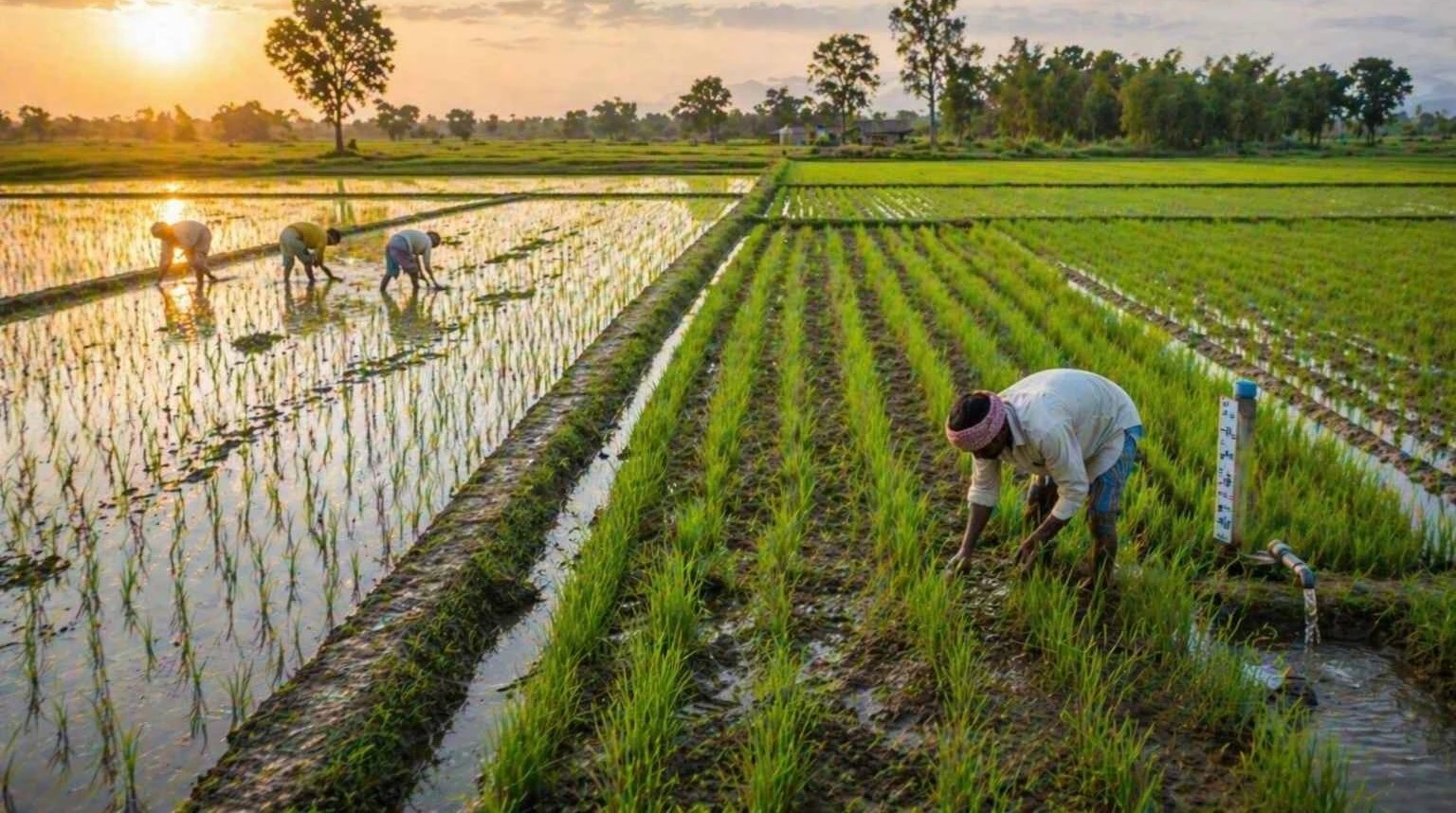
SRI flips the conventional rice playbook on its head. Instead of densely planting older seedlings into flooded fields, SRI uses single, very young seedlings, spaced widely, in intermittently irrigated soil. The result is a stronger root system, healthier plants, and a dramatically lower water and methane footprint.
Field trials across Tamil Nadu, Andhra Pradesh, and Karnataka consistently show 30–50% lower water usage, 30–60% lower methane emissions, and yield improvements of 20–50% compared with conventional methods. Today more than 5 million Indian farmers practice some version of SRI, making it one of the largest agro-ecological transitions in the world.
“SRI is not a technology. It is a way of paying attention — to the seedling, the soil, and the water — that happens to produce more food with less harm.”
Direct-Seeded Rice & Alternate Wetting and Drying (AWD)
Direct-Seeded Rice (DSR) skips the labor-intensive transplanting step by sowing seeds directly into prepared fields. This single change can reduce water use by 25–40% and labor by up to 50%, while cutting methane emissions significantly. India has been actively promoting DSR through national missions over the past five years.
Alternate Wetting and Drying (AWD) is another simple but powerful technique — instead of keeping the paddy continuously flooded, water is drained periodically and the soil allowed to dry briefly before reflooding. AWD typically reduces water use by 20–30% and methane emissions by 30–70%, with no significant loss of yield. Together, SRI, DSR, and AWD form the climate-smart core of modern paddy farming.
Integrated Pest Management & Natural Polycultures
Sustainable rice is not just about water and methane — it is also about chemistry. Integrated Pest Management (IPM) replaces blanket pesticide spraying with biological controls (predator insects, pheromone traps), crop rotation, and targeted, threshold-based intervention. The result is healthier paddies, cleaner water tables, and lower input costs for farmers.
Many of our partner farms also practice traditional polycultures — fish-paddy systems, duck-paddy systems, and azolla-paddy systems — where one component nourishes another, reduces pest pressure naturally, and provides farmers with multiple income streams from the same plot of land.
Climate-smart practices used on our partner farms
- System of Rice Intensification (SRI) with intermittent irrigation
- Direct-Seeded Rice (DSR) instead of transplanting
- Alternate Wetting and Drying (AWD) water management
- Integrated Pest Management (IPM) and biological pest control
- Fish-rice and duck-rice polycultures
- Azolla and green-manure cover cropping
Energy, Packaging & Smart Logistics
Sustainability doesn't end at the farm gate. Modern Indian rice mills increasingly recover rice husk — a high-energy biomass byproduct — to generate steam and electricity for parboiling and milling, dramatically reducing fossil-fuel dependence. Solar rooftops, variable-frequency drives, and energy-efficient drying lines now appear across the country's leading processing facilities.
Packaging is moving from non-recyclable laminates to mono-material, recyclable, and increasingly bio-based films. Shipping is being optimized with container-fill modelling and route planning to reduce per-tonne CO₂ emissions. Each of these moves quietly compounds into a meaningfully lower-carbon export pipeline.
Why Sustainable Sourcing Matters for Buyers Worldwide
European retailers must now report scope-3 emissions across their supply chains. American food brands are committing to net-zero by 2040. Middle Eastern importers serving global hospitality groups are under similar pressure. Buyers everywhere need rice they can defend in front of regulators, consumers, and ESG-rating agencies.
By sourcing from TRS Bharat, importers receive documentation across the entire chain — farm origin, irrigation method, processing energy mix, packaging composition, and shipping footprint. That paper trail is no longer a 'nice to have'. It is the licence to operate in tomorrow's food markets — and the foundation of a partnership built to last.
Key Takeaways
- Conventional rice farming carries a heavy water and methane footprint markets will increasingly price in.
- SRI methods cut water by 30–50% and methane by 30–60% while raising yields.
- Direct-Seeded Rice and AWD techniques further reduce water and emissions without yield loss.
- Integrated Pest Management and polycultures cut chemical inputs and increase farm resilience.
- Modern milling, biomass energy, and recyclable packaging are reshaping the post-harvest footprint.
- Documented sustainability is becoming a regulatory requirement, not a marketing choice.
In Closing
Sustainable rice is not a niche — it is the only rice with a future in tomorrow's global trade. For TRS Bharat, sustainability is the strategy that lets us promise our farmers, our customers, and our planet a partnership that lasts beyond a single harvest.
Written by
TRS Bharat Editorial Team
Sustainability & Sourcing · TRS Bharat Global Solutions